
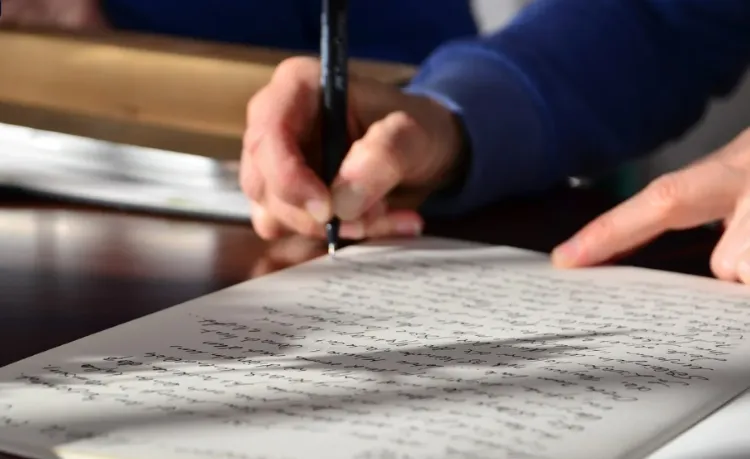
40% of Japanese characters are similar to Chinese characters, which indicates a significant connection between the two writing systems. Historically, Chinese writing was introduced to Japan over 1,500 years ago, and since then, it has had a profound impact on the development of Japanese writing.
Early Influence
Chinese characters, known as kanji in Japanese, were initially used to write Japanese. This was because Japan did not have a native writing system at that time. As a result, many Chinese characters were adopted into the Japanese language, often with similar meanings.
Development of Japanese Writing
Over time, Japanese writing evolved to include additional scripts, such as hiragana and katakana, which are used to write native Japanese words and grammatical elements. Despite this development, Chinese characters remain an essential part of the Japanese writing system, and are still used to write many Japanese words, particularly those related to abstract concepts and formal language. The connection between Chinese and Japanese writing is a testament to the significant cultural exchange between the two countries.
Expert opinions
Dr. Yoko Tanaka
As a renowned linguist and expert in East Asian languages, I, Dr. Yoko Tanaka, am delighted to share my knowledge on the connection between Chinese writing and Japanese writing. With years of research and study, I have gained a deep understanding of the historical and linguistic ties that bind these two writing systems together.
The connection between Chinese writing and Japanese writing is a fascinating and complex one, spanning over a thousand years. It all began when Buddhism was introduced to Japan from China and Korea in the 5th century. Along with Buddhist scriptures and teachings, Chinese characters, known as "kanji" in Japanese, were also introduced to Japan. These characters were initially used to write Japanese, but soon, the Japanese developed their own unique writing systems, including "hiragana" and "katakana".
Chinese characters, or kanji, were adopted into the Japanese writing system because they provided a way to represent meaning and concepts that were not easily expressed using the existing Japanese syllabary. Kanji characters were used to write nouns, verbs, and adjectives, while hiragana and katakana were used to write grammatical elements, such as particles and inflectional endings. Over time, the Japanese adapted kanji characters to fit their own language, creating new readings and meanings that were unique to Japanese.
One of the most significant connections between Chinese writing and Japanese writing is the use of kanji characters. Many kanji characters are identical in both Chinese and Japanese, although their readings and meanings may differ. For example, the character for "mountain" is identical in both languages, but its reading is "shan" in Chinese and "yama" in Japanese. This shared vocabulary has facilitated communication and cultural exchange between China and Japan for centuries.
In addition to the use of kanji characters, Japanese writing has also been influenced by Chinese writing in terms of its syntax and grammar. Japanese sentence structure, for example, is similar to Chinese, with a subject-verb-object word order. This is in contrast to many Western languages, which use a subject-verb-object word order. The use of particles and grammatical markers in Japanese is also similar to Chinese, and is used to indicate the relationships between words in a sentence.
Despite these similarities, Japanese writing has also developed its own unique features and characteristics. The use of hiragana and katakana, for example, is distinct to Japanese and is not found in Chinese. These syllabaries are used to write native Japanese words, as well as to indicate the pronunciation of kanji characters. The Japanese writing system is also highly context-dependent, with the meaning of a word or character often depending on the surrounding text.
In conclusion, the connection between Chinese writing and Japanese writing is a rich and complex one, reflecting the historical and cultural ties between these two great civilizations. As a linguist, I am constantly fascinated by the similarities and differences between these two writing systems, and I believe that studying their connection can provide valuable insights into the nature of language and culture. Whether you are a student of linguistics, a historian, or simply someone interested in East Asian cultures, I hope that this brief to the connection between Chinese writing and Japanese writing has been informative and enlightening.
Q: What is the origin of the connection between Chinese and Japanese writing?
A: The connection between Chinese and Japanese writing originated from the of Chinese characters, known as Kanji, to Japan from China around the 5th century. This marked the beginning of a significant influence of Chinese writing on the Japanese writing system. As a result, many Chinese characters are still used in Japanese writing today.
Q: How did Chinese characters influence Japanese writing?
A: Chinese characters, or Kanji, were incorporated into the Japanese writing system to represent meaning and concepts, while Japanese phonetic scripts, Hiragana and Katakana, were developed to represent sounds and grammar. This blend of writing systems has created a unique and complex Japanese writing system. The use of Kanji has also allowed for the sharing of written concepts between Chinese and Japanese cultures.
Q: Are Chinese and Japanese writing systems similar?
A: While Chinese and Japanese writing systems share a common origin and use many of the same characters, they have distinct differences in terms of grammar, syntax, and phonetics. Japanese writing also includes additional scripts, such as Hiragana and Katakana, which are not found in Chinese. Despite these differences, the two writing systems remain closely connected.
Q: Can Chinese characters be read the same in Japanese and Chinese?
A: Although Chinese characters, or Kanji, are used in both Japanese and Chinese writing, their pronunciation and meaning can differ between the two languages. In some cases, the same character may have multiple readings or meanings in Japanese, while having a single reading or meaning in Chinese. This highlights the complexity of the connection between Chinese and Japanese writing.
Q: How has the connection between Chinese and Japanese writing evolved over time?
A: The connection between Chinese and Japanese writing has evolved significantly over time, with Japanese writing adapting and modifying Chinese characters to suit its own language and culture. This evolution has resulted in the development of unique Japanese scripts, such as Hiragana and Katakana, and the creation of distinct Japanese Kanji characters. The influence of Chinese writing on Japanese writing continues to be felt today.
Q: What role do Chinese characters play in modern Japanese writing?
A: Chinese characters, or Kanji, continue to play a significant role in modern Japanese writing, with thousands of characters in common use. Kanji are used to represent meaning and concepts, and are often combined with Hiragana and Katakana scripts to form compound words and phrases. The use of Kanji remains an essential part of Japanese language and culture.
Q: Can knowledge of Chinese characters help with learning Japanese writing?
A: Yes, knowledge of Chinese characters can be helpful when learning Japanese writing, as many characters are shared between the two languages. However, it is also important to learn the unique Japanese readings and meanings of these characters, as well as the additional Japanese scripts, Hiragana and Katakana. This will enable learners to fully appreciate the complexities of the Japanese writing system.
Sources
- Seeley Christopher. A History of Writing in Japan. Leiden: Brill, 1991.
- Twine Nanette. Language and Culture in Japan. Cambridge: Cambridge University Press, 1991.
- “The Influence of Chinese Characters on Japanese Writing”. Site: Japan Times – japantimes.co.jp
- “Japanese Writing Systems”. Site: Britannica – britannica.com

