

Most American university students face the reality that poor essay structure leads to lower grades and endless frustration. Academic writing success depends on more than knowing facts—it requires organizing ideas into a clear framework that guides the reader. Mastering essay structures can help you break free from confusion and create arguments that stand out to professors, no matter your field or nationality.
Table of Contents
- Defining Essay Structure And Core Misconceptions
- Key Components Of Effective Essay Organization
- Major Types Of Structured Academic Essays
- How Structure Influences Clarity And Argument
- Common Pitfalls Of Poor Essay Organization
- Strategies For Improving Essay Structure Skills
Key Takeaways
| Point | Details |
|---|---|
| Importance of Structure | A clear essay structure enhances clarity and helps convey complex arguments effectively. |
| Thesis Development | A strong, specific thesis statement provides essential direction and focus for your essay. |
| Coherent Progression | Logical paragraph progression, supported by transitions, strengthens the overall narrative flow. |
| Understanding Essay Types | Familiarity with different essay types allows students to tailor their writing to specific academic expectations. |
Defining Essay Structure and Core Misconceptions
Academic essays require more than random paragraphs strung together. They demand a strategic framework that transforms scattered thoughts into compelling arguments. Academic essay structures serve as roadmaps guiding readers through intellectual terrain, ensuring clarity and coherence.
At its core, an essay structure encompasses three fundamental components: introduction, body, and conclusion. The introduction presents your central thesis, providing context and direction. Body paragraphs develop your argument systematically, presenting evidence and analysis. The conclusion synthesizes key points, reinforcing your original argument’s significance. Many students mistakenly view these elements as rigid formulas, but they are actually flexible frameworks designed to communicate complex ideas effectively.
Common misconceptions about essay structure often stem from high school writing experiences. University-level essays require more nuanced approaches. While school essays might prioritize basic five-paragraph formats, academic writing demands deeper critical thinking. Your structure should reflect intellectual depth, demonstrating sophisticated reasoning rather than mechanical adherence to preset templates. This means crafting paragraphs that connect logically, using transitions that guide readers through your argument’s progression.
Pro Tip: Always outline your essay before writing to ensure logical flow and coherent argument development.
Key Components of Effective Essay Organization
Creating a well-structured academic essay requires strategic planning and deliberate organization. Systematic academic writing demands careful attention to how arguments are constructed and presented. The most effective essays are not just collections of paragraphs, but carefully choreographed intellectual journeys that guide readers through complex ideas.
Three critical components form the backbone of exceptional essay organization. First, a clear thesis statement serves as the essay’s central argument, providing immediate direction and focus. This thesis should be specific, debatable, and positioned strategically within the introduction. Second, logical paragraph progression ensures that each section builds upon the previous one, creating a coherent narrative flow. Each paragraph should connect seamlessly, using transitional phrases that demonstrate how ideas relate and evolve. Third, evidence integration plays a crucial role. Academic arguments must be supported by credible sources, expert perspectives, and empirical data that substantiate the central claim.

Successful essay organization also requires understanding the relationship between structure and critical thinking. Paragraphs are not merely containers for information but dynamic spaces where ideas interact, challenge each other, and develop nuanced arguments. This means moving beyond simple chronological or descriptive approaches to create analytical frameworks that demonstrate intellectual sophistication. Students must learn to arrange their thoughts in ways that reveal complex relationships, anticipate potential counterarguments, and present multilayered perspectives.
Pro Tip: Create a detailed outline before writing that maps out your thesis, key arguments, and supporting evidence to ensure a coherent essay structure.
Major Types of Structured Academic Essays
Academic writing encompasses diverse essay types, each serving a unique purpose in scholarly communication. Primary academic essay categories represent sophisticated tools for intellectual exploration and critical thinking. Understanding these variations allows students to adapt their writing approach to specific academic requirements and disciplinary expectations.
Four primary academic essay types dominate scholarly writing. Argumentative essays represent the most rigorous form, demanding students construct evidence-based arguments that critically analyze complex topics. These essays require thorough research, logical reasoning, and the ability to present counterarguments effectively. Expository essays focus on explaining complex concepts, breaking down intricate ideas into comprehensible components. They prioritize clarity, utilizing precise language to inform and educate readers. Narrative essays offer a more personal approach, allowing writers to share experiences through storytelling techniques that engage emotional and intellectual dimensions. Descriptive essays emphasize sensory details, painting vivid pictures that transport readers into specific environments, experiences, or perspectives.
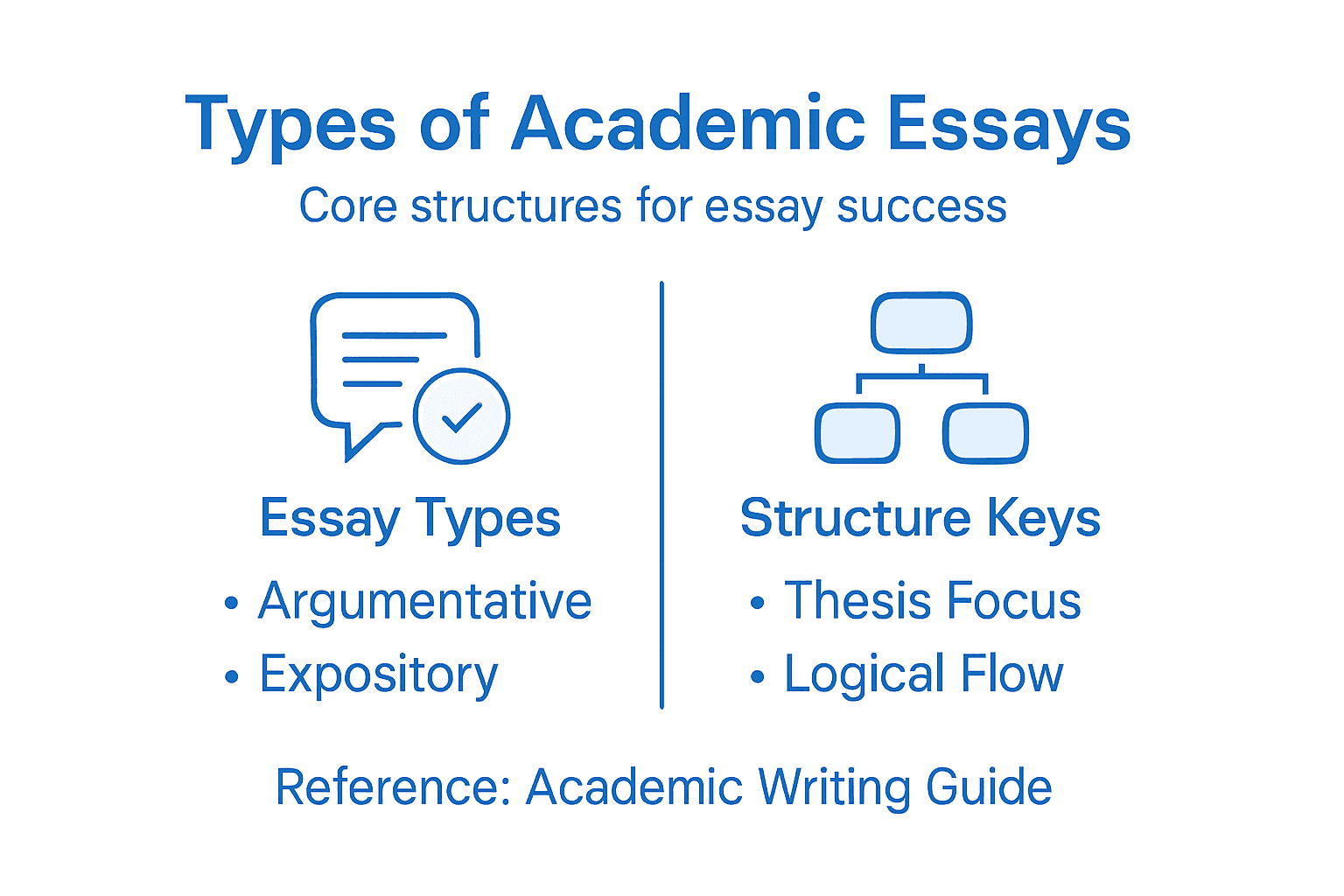
Each essay type demands a unique structural approach and intellectual strategy. Argumentative essays require a strong thesis, systematic evidence presentation, and analytical depth. Expository essays need clear explanatory frameworks that progressively unveil complex information. Narrative essays rely on chronological progression and personal insights, while descriptive essays depend on rich, evocative language that creates immersive experiences. Students must recognize that mastering these formats involves more than following mechanical templates—it requires developing nuanced communication skills that demonstrate critical thinking and scholarly sophistication.
Here’s a quick reference of the major academic essay types and their main distinguishing features:
| Essay Type | Primary Purpose | Typical Structure | Key Success Factor |
|---|---|---|---|
| Argumentative | Prove a specific claim | Thesis, evidence, rebuttal | Strong thesis, rebuttals |
| Expository | Explain complex concepts | Sequential topic breakdown | Clear, logical flow |
| Narrative | Share experiences | Chronological storytelling | Vivid, engaging details |
| Descriptive | Create sensory immersion | Thematic or spatial order | Sensory-rich language |
Pro Tip: Practice adapting your writing style by analyzing sample essays from different academic disciplines to understand how essay types vary across fields.
How Structure Influences Clarity and Argument
Essay structure is the fundamental architecture that transforms scattered ideas into compelling intellectual arguments. Paragraph coherence techniques determine how effectively readers comprehend and engage with complex academic writing. Like a well-designed blueprint, a strategic essay structure guides readers through intricate reasoning pathways, ensuring each idea connects logically and persuasively.
The relationship between structure and argument is deeply symbiotic. Paragraph sequencing acts as a critical mechanism for developing intellectual momentum. Each paragraph functions as a micro-argument, building upon previous insights while setting the stage for subsequent points. Strong essays create a sense of progressive discovery, where readers feel they are actively participating in an intellectual journey. Transitional phrases serve as critical signposts, helping readers navigate complex arguments by revealing connections, highlighting contrasts, and demonstrating causal relationships between ideas. This deliberate architectural approach transforms essays from mere collections of paragraphs into sophisticated analytical instruments.
Effective essay structure goes beyond mechanical organization—it reflects intellectual sophistication. Skilled writers understand that structure is not a constraint but a dynamic tool for critical thinking. Paragraphs should flow like a carefully choreographed intellectual dance, with each movement purposeful and interconnected. The introduction establishes the conceptual landscape, body paragraphs explore nuanced perspectives, and the conclusion synthesizes insights, creating a comprehensive understanding that is greater than the sum of individual arguments. By mastering structural techniques, students can elevate their writing from descriptive to truly analytical, demonstrating not just what they know, but how they think.
Pro Tip: Develop a reverse outline after completing your first draft to verify that each paragraph logically supports your central thesis.
Common Pitfalls of Poor Essay Organization
The path to academic writing excellence is often obstructed by fundamental organizational mistakes. Poor essay organization tactics can transform potentially brilliant arguments into confusing, ineffective documents. Understanding these critical errors helps students develop more sophisticated writing strategies and avoid common academic writing traps.
Weak thesis development represents one of the most significant organizational pitfalls. Many students struggle to craft a clear, specific thesis that provides genuine direction for their essay. A vague or overly broad thesis creates a domino effect of structural problems, causing paragraphs to meander without purpose. Additionally, inconsistent paragraph progression undermines argumentative coherence. When paragraphs lack logical connections or fail to build upon each other systematically, readers become disoriented, struggling to follow the essay’s central argument. This lack of connectivity transforms potentially compelling writing into a disjointed collection of disconnected ideas.
Another critical organizational error involves neglecting transitional elements that guide readers through complex arguments. Academic essays require sophisticated navigation mechanisms—subtle linguistic bridges that demonstrate how ideas relate and evolve. Without these critical connective tissues, paragraphs appear as isolated islands of thought, preventing readers from understanding the comprehensive intellectual landscape. Students must recognize that essay organization is not merely about presenting information, but creating an intellectual journey that reveals nuanced thinking. Effective essays demonstrate not just what students know, but how they analyze, synthesize, and critically engage with complex concepts.
The following table summarizes frequent essay structure mistakes and strategies for overcoming them:
| Common Mistake | Why It Hurts Essays | How to Fix It |
|---|---|---|
| Weak thesis statement | Argument lacks direction | Refine and clarify main claim |
| Disconnected paragraphs | Causes reader confusion | Use clear transitions |
| Ignored counterarguments | Misses complexity | Address opposing views |
| Unsupported assertions | Weakens credibility | Include solid evidence |
Pro Tip: Create a reverse outline after completing your draft to verify each paragraph’s precise contribution to your central argument.
Strategies for Improving Essay Structure Skills
Mastering academic essay structure requires intentional skill development and strategic practice. Effective essay writing techniques transform scattered thoughts into coherent intellectual arguments. The journey from disorganized writing to structured prose demands commitment, practice, and a systematic approach to developing writing skills.
Three fundamental strategies can dramatically enhance essay structure proficiency. First, develop a comprehensive outlining habit. Creating detailed outlines before drafting helps writers map their arguments, ensuring logical progression and clear connections between ideas. Outlines act as architectural blueprints, revealing potential structural weaknesses before they emerge in the final draft. Second, practice strategic paragraph construction. Each paragraph should function as a mini-argument, featuring a clear topic sentence, supporting evidence, and a transitional element that connects to subsequent paragraphs. This approach transforms paragraphs from isolated units into interconnected components of a larger intellectual argument. Third, cultivate critical reading skills. By analyzing how accomplished writers structure their essays, students can internalize sophisticated organizational techniques, learning to recognize and replicate effective argumentative frameworks.
Improving essay structure is an ongoing process of deliberate practice and self-reflection. Writers must develop a habit of critically examining their own work, identifying areas where organizational clarity can be enhanced. This means regularly reviewing essay drafts, seeking feedback from instructors or peers, and being willing to deconstruct and rebuild arguments. Successful academic writers understand that structure is not a rigid template but a dynamic tool for intellectual exploration. By viewing essay organization as a flexible, creative process, students can develop writing skills that extend far beyond academic assignments.
Pro Tip: Dedicate time each week to analyzing professional academic writing, focusing specifically on how authors construct and connect their arguments.
Unlock Academic Success by Mastering Essay Structure
Struggling with creating clear thesis statements or connecting your paragraphs logically can keep your essays from reaching their full potential. This article highlights common challenges like weak thesis development and inconsistent paragraph progression that can confuse your readers and weaken your argument. If you want to transform your writing into a coherent, analytical masterpiece that reflects your critical thinking skills, effective essay organization is the key.

Discover practical strategies and expert guidance to improve your essay structure and argument clarity at au-bestessays.org. Whether you want to refine your outlining skills or learn how to integrate evidence smoothly, our comprehensive resources will help you build essays that stand out. Start mastering the art of academic writing today and unlock the success you deserve by visiting Essay Writing Tips now.
Frequently Asked Questions
What are the key components of a well-structured academic essay?
A well-structured academic essay includes three main components: an introduction with a clear thesis statement, body paragraphs that systematically develop the argument with evidence and analysis, and a conclusion that synthesizes the key points and reinforces the thesis.
How does essay structure influence clarity in writing?
Essay structure enhances clarity by providing a logical framework that guides readers through complex ideas. A coherent structure allows arguments to flow logically, making it easier for readers to follow the writer’s reasoning and understand the overall message.
What are some common misconceptions about essay structure?
Many students believe that essay structure is a rigid formula, often based on their high school experiences. In reality, effective academic writing requires flexibility and the ability to adapt structure to fit nuanced arguments, rather than strictly adhering to preset templates.
How can I improve my essay organization skills?
Improving essay organization skills can be achieved through three main strategies: developing a comprehensive outlining habit before writing, practicing the construction of cohesive paragraphs with clear connections, and cultivating critical reading skills to analyze the organization of accomplished writers.
Recommended
- What are the five strategies for academic success? – Best Essays
- What are 5 traits of a successful student? – Best Essays
- What are structural techniques in creative writing? – Best Essays
- What are the 6 factors that shape academic writing? – Best Essays
=

